
How Can You Stand Out Among Thousands of French Teachers?
As a teacher of French as a foreign language, I sometimes wonder: why would a student choose me? And how can I make them want to learn with me at a rate that lets me earn a decent living? Preparing lessons, teaching, adapting materials and supporting students all take work. That work has value.

Calling my lessons “personalized,” “dynamic” or “tailored to your goals” doesn’t really tell students what makes them different. They see those words everywhere. I want them to know what learning with me actually looks like.
My answer is to offer blended learning: lessons with me and a space where students can keep learning between sessions.
The lesson itself is still at the heart of learning. That’s when we talk things through, explain what’s tricky and adjust as we go. With EspaceProfFLE worksheets and activities, though, your support can extend well beyond that hour. Depending on your student’s needs and pace, a single lesson can lead to two or three hours of learning in total, including time with you and independent activities to revisit and practice what you’ve covered.

Students pay for a lesson, but the fee covers much more than the time you spend together. It includes your guidance, thoughtfully designed materials, exercises with instant feedback, games and interactive quizzes.
But what makes students want to keep going? How can you make that practice genuinely useful and help them see it as part of the value of a lesson instead of one more chore?
1. Conjugation wheels: turn verb practice into a game
The present, the imperfect, the future… Whatever tense you’re teaching, the goal is for students to use verbs without stopping to think through every ending. In conversation, we need those forms to come naturally. That’s often where students get stuck. They know the rule, but the right form doesn’t come to mind when they need it.
So why not turn that practice into a game?
With the conjugation wheels, students spin, see which combination comes up and try to find the correct verb form. Then they spin again for a new combination and a fresh challenge.
Watch the present subjunctive wheels in action:
In a one-to-one lesson, you can play together, give your student time to think, then ask them to use the verb in a short sentence. Straight away, they’re using that verb to say something.
In a group, you can add a challenge. Who can find the answer first? Or have students play in teams so they can help one another. Wanting to win gives them a good reason to pay attention, listen to the answers and have another go.
There are conjugation wheels for the présent, passé composé, imparfait, futur simple, conditionnel présent and subjonctif présent. You’ll find them at the end of the relevant module or in the worksheet description.
2. French articles: how about a little grocery shopping?
Un, une, du, de la, de l’, des… French articles can be quite a challenge!
We explain, give examples and offer corrections. Yet as soon as students start speaking, the hesitation returns.
Your student can also practice without leaving home… by doing the grocery shopping in French.
That’s the idea behind Mon caddie. Students practice food vocabulary and articles through a familiar task: choosing what to put in their shopping cart.
Watch Mon caddie in action:
Start during the lesson. Name the foods, look at the articles and try a few examples together. Then your student can carry on independently, at their own pace. At the next lesson, use the contents of their cart to start a conversation: “Qu’est-ce que tu as acheté ?” and “Qu’est-ce que tu vas préparer ?” Students can see the point of practicing when it gives them something to talk about.
You can also try Le dressing de Léa for clothing vocabulary, Qui suis-je ? and Atelier des portraits for describing faces, Mon arbre généalogique, Je meuble ma maison and La montre for telling the time. Look for the games at the bottom of the relevant module page.
3. Exercises with instant feedback
French grammar has a reputation for being difficult. Take personal pronouns. Your student knows the rule, but when it’s time to speak, they still hesitate between “je la vois” and “je lui parle.” For the right pronoun to come naturally, they need to hear it in sentences, read it and use it themselves more than once.
I don’t know about you, but the thought of a painfully dull workbook doesn’t appeal to me either! We all know how that ends. The student puts off those three pages, and if they eventually do them, we spend the evening marking them.
On EspaceProfFLE, you can choose an interactive exercise on the very point you’ve just covered together. Send your student the link and let them play! They can try an answer, get feedback straight away and try again as often as they like. And you? Nothing to mark. At the next lesson, you can spend that time on conversation. You’ll find the exercises at the bottom of each module page.
Here’s how it works with personal pronouns:
4. Quizzes and vocabulary pages to take learning further
Don’t forget our quizzes! They help you see what your students have learned while building on the work you started in class. Familiar words appear in new contexts, students reuse structures they’ve practiced, and different topics come together. To answer new questions, students have to draw on what they already know.

You receive a marked copy by email. You can go over it together to see how far your student has come, clear up a difficulty and decide what needs a little more practice.
To build vocabulary, try our picture dictionaries with audio. Students choose a topic, look at the pictures, listen to the words and repeat them at their own pace. They can use the dictionaries to prepare for their next lesson or revisit the words they’ll need to tell a story, describe something or chat with you.
5. SOS Grammaire: a quick way to look up a rule
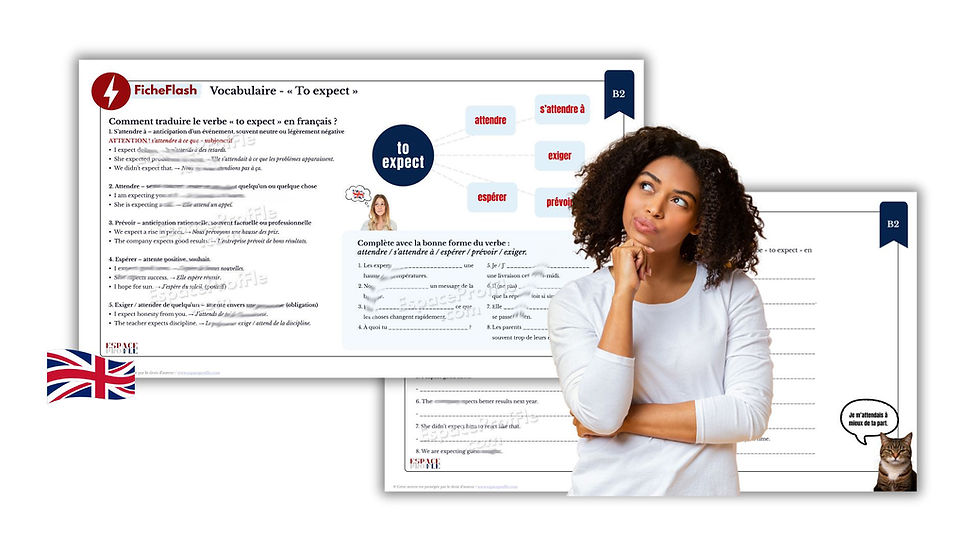
What if your student is unsure about a rule between lessons? SOS Grammaire offers concise grammar explanations in French and English, with plenty of examples that show how each structure works and how to use it.
Students can revisit a topic, check a specific point and find the explanation they need to carry on with an activity. The English explanations also help when reading the rules in French still feels like hard work.

During the lesson, you can read an explanation together, look at the examples and move on to the interactive exercises. Between lessons, your student can return to the same resource and gradually learn to find answers independently.
Your lesson fee also covers that ongoing support. Between sessions, students have activities they can access and a clear goal. There’s no need to buy a new textbook at every level, complete with a CD-ROM that ends up in a drawer.
Best of all, your students can access the materials you share with them free of charge. There’s no extra subscription to pay for. Their learning space is free too, and it brings together the resources you’ve chosen for them.

Meanwhile, your teacher space and calendar on EspaceProfFLE help you organize the support you offer. Your lessons, materials and between-session practice all fit together.
Whether you teach online or in person, one-to-one or in groups, at a community organization, on Preply or as a private tutor, EspaceProfFLE helps you spend less time preparing and offer your students more.

What do you think? Do your students enjoy these new ways of learning? What makes them want to keep going between lessons? I’d love to hear about your experience.
Tell me in the comments!



Commentaires